


Hole Busters 3D
DREAMPLAY
Hole Busters 3D is the kind of puzzle game I can open for a short break without needing to learn a complicated control system first. The central idea is easy to understand: guide a black hole through a three-dimensional scene and clear what is in its path. That simplicity makes the first few minutes welcoming, while the changing layouts give the basic action enough variety to keep it from feeling like a single repeated gesture.
I reviewed it as a first-time player, paying particular attention to the moment between installation and the first satisfying success. That is where many casual games either make sense immediately or lose the player. Here, the appeal becomes clear quite quickly, but the game is best understood as a relaxing, lightweight puzzle experience rather than a deep strategy title. If you want something calm for short sessions, it has a strong starting point. If you need complex planning, a large narrative, or a highly competitive challenge, you may eventually want a different kind of puzzle game.
What the first few minutes feel like
Developed by DREAMPLAY, this free puzzle game puts its visual gimmick at the center of the experience. The black hole is not just decoration; it is the tool you use to interact with the level. Objects disappear as the hole moves over them, which gives every successful action an immediate visual payoff. I found that satisfying because the game communicates progress through what I can see rather than forcing me to study a long explanation.
The three-dimensional presentation also changes how I read each level. I am not simply matching colored pieces or arranging flat tiles. I need to look at the space in front of me, notice what can be collected, and think about the order in which the area should be cleared. That makes the game more tactile than a conventional grid puzzle, even though the underlying goal remains approachable.
The store presents it as a relaxing black-hole game, and that description matches the mood more than the difficulty. The movement and collection loop are naturally soothing, particularly when I am playing without trying to rush. Still, relaxing does not mean completely thoughtless. The most enjoyable moments come when I pause for a second, identify the useful route, and then watch the hole consume a sequence of objects cleanly.
Related News






The best reason to try it is the quick feedback between movement and reward. A short session can feel complete without requiring a long commitment, which makes it suitable for waiting rooms, short commutes, or the few minutes before bed. The trade-off is that players who prefer elaborate puzzles may find the core interaction deliberately simple.
The game is available at no upfront cost and is rated for Everyone, so it is positioned as an accessible choice for a broad audience. It has reached over 100 thousand installs and holds a 4.7 average from around 11 thousand ratings, which suggests that the straightforward format has found an audience. I would still treat those figures as a sign of broad appeal rather than a guarantee that every puzzle fan will enjoy the same pace.
Who will probably enjoy it
I would recommend it first to casual players who like games that explain themselves through interaction. It is also a good fit for someone who enjoys the visual pleasure of clearing a space but does not want a demanding match-three system, a timer-heavy arcade game, or a long story campaign. Younger players can understand the basic objective quickly, while adults may appreciate how little preparation is needed before a short break becomes a playable session.
Gallery
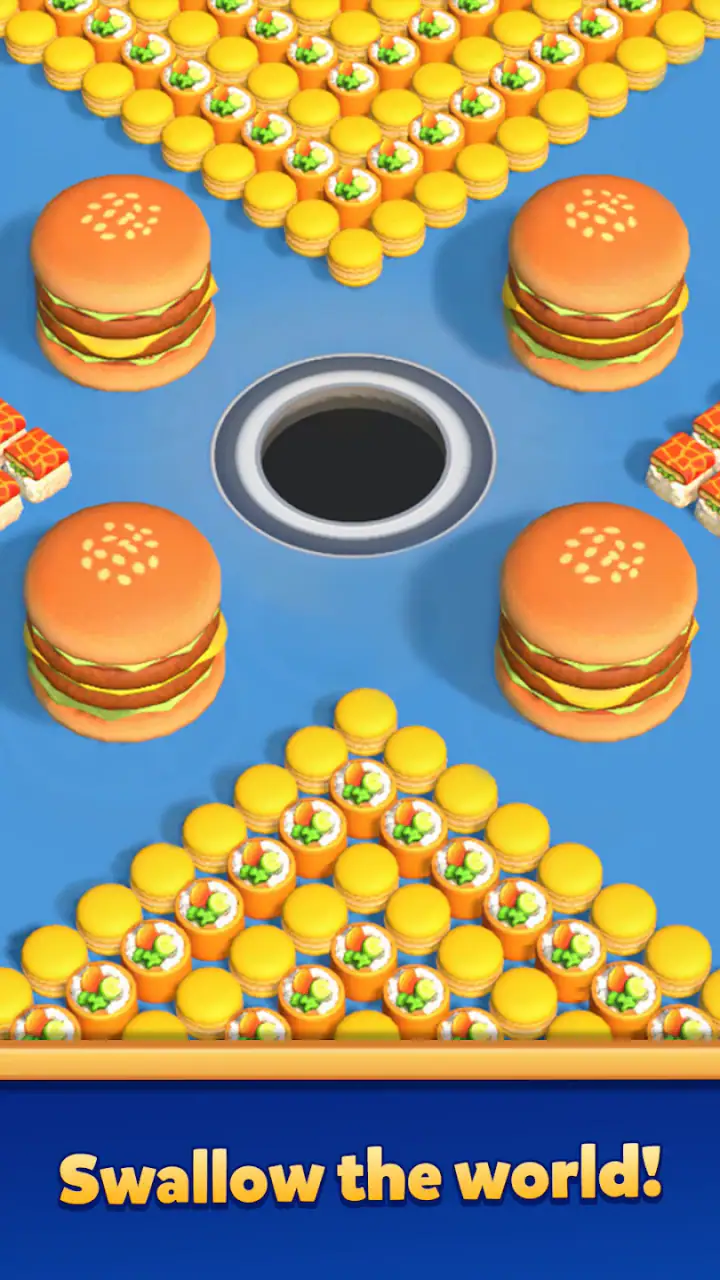
It is less suitable for someone looking for a puzzle game built around deduction, wordplay, intricate physics, or a carefully layered campaign. The black-hole concept is the main attraction, not a wrapper around a large collection of unrelated mechanics. That focus gives it personality, but it also means the experience depends heavily on whether you enjoy repeating the same broad interaction across different situations.
Getting started without overthinking the setup
Installation is uncomplicated because the game is free to download and supports devices running Android 7.0 or later. After opening it, I would recommend treating the first level as a tutorial even if the game does not ask me to read a long manual. The most useful approach is to move slowly at first, watch how the hole responds, and pay attention to which objects disappear when it passes over them.
That small pause matters. A player who immediately drags or steers without looking may finish the opening objective but miss how the space is arranged. I prefer to scan the whole visible area before making the first committed movement. In a game based on consuming objects, the order of collection can be more important than simply reaching the nearest item.
One practical habit is to separate the level into reachable groups. I first look for objects that are clearly exposed, then consider whether clearing them will open a safer or more useful route. This is more reliable than moving randomly around the scene. It also makes the game feel like a puzzle rather than a simple sweep across the screen.
Another helpful adjustment is to use the opening moments to learn the scale of the hole. The hole’s ability to absorb objects is central to the feedback loop, so I do not assume that every object can be collected in exactly the same way. I watch what happens, then adapt my route. This is especially useful for a first-time user who may expect the game to behave like a standard top-down maze.
The current version is 1.6.3, and the title has been available since February 17, 2025. Those details are useful when checking compatibility or comparing the version shown on a device with the one described in an app catalog. For ordinary play, however, the important first step is simpler: install it, open a level, and let the interaction teach you before searching for an advanced technique.
How I reach the first meaningful success
My advice for the first level is to avoid chasing speed. I begin by identifying the largest obvious cluster or the most accessible line of objects, then guide the hole through it in a controlled path. The first meaningful success is not merely completing a level; it is recognizing that the route can be planned instead of improvised.
Once I see that, I use a three-part rhythm. I scan, move through a manageable group, and then stop briefly to reassess the new space. That pause prevents a common mistake: continuing in the same direction after the scene has changed. Clearing objects can alter what is visible or what seems reachable, so the best route at the beginning may not remain the best route later.
If the first attempt feels messy, I do not interpret that as failure of the game. The control idea is simple, but spatial judgment still takes a moment. I try again with a wider view of the level and fewer unnecessary movements. The improvement is usually more satisfying than simply repeating the same path, because I can tell that I am learning how the puzzle is arranged.
For a child or another new player, I would explain the goal in plain language: move the hole over the objects you need to clear, watch what happens, and change direction when the visible route stops making sense. That explanation is enough to begin. I would avoid giving too many instructions at once, since the visual feedback does a better job than a detailed lecture.
A useful everyday scenario is a short coffee break. I can start a level, make a few deliberate moves, and stop when the break ends without needing to remember a complicated story or a large inventory. The game works well in that setting because its central action is immediately recognizable and its relaxed presentation does not demand the same concentration as a serious competitive puzzle.
Where new players can get confused
The most likely confusion is assuming that the nearest object is always the correct first target. In a three-dimensional level, proximity and usefulness are not necessarily the same thing. I get better results when I look at the whole arrangement and consider what clearing one group might make easier next. That is a small but important shift from reacting to planning.
Another point of friction is the difference between movement and progress. Moving the hole around may feel active, but not every movement helps complete the objective. When I catch myself circling without collecting anything useful, I stop and reset my visual plan. The game becomes calmer once I treat movement as a tool for reaching a sequence of targets rather than as the goal itself.
Players may also wonder whether they should rush through a level to get the best experience. My answer is no, at least not initially. Speed can become a personal challenge later, but careful movement is the better way to understand the game. Rushing before learning the layout can turn a relaxing puzzle into a frustrating series of corrections.
The free model deserves attention as well. The game costs nothing to start, but it includes in-app purchases ranging from $0.99 to $104.99 per item. I would not spend anything during the opening session. First, I would decide whether the basic black-hole loop remains enjoyable after several levels. That is the fairest way to judge value, especially when the appeal comes from a focused mechanic rather than a broad set of systems.
For families, the Everyone age rating makes the game easier to consider as a general-audience download, but I would still explain that optional purchases can appear in a free game. The rating describes suitability of content, not a promise that every part of the experience is entirely free. That distinction is worth keeping in mind when a child is playing on a shared device.
Small habits that make the puzzles smoother
My first tip is to use the edges of the level as visual anchors. When the scene feels busy, I locate the boundary or a clearly recognizable object and mentally divide the space into sections. That reduces the temptation to make random movements and helps me remember which area I have already cleared.
My second tip is to reassess after a successful collection rather than holding the same direction automatically. The satisfying disappearance of objects can make me want to continue immediately, but a short pause often reveals a better next target. This is especially effective when several objects are close together but only one of them opens a useful route.
My third tip is to treat failed attempts as route experiments. I note where I lost control or began moving without a purpose, then try the same level with one change instead of starting over emotionally. That approach keeps the tone relaxed and turns a minor mistake into information about the layout.
A fourth tip is to play in short, intentional sessions. Because the main mechanic is easy to resume, I do not need to force a long run. Stopping after a satisfying completion can actually preserve the game’s relaxing quality better than continuing until the interaction feels repetitive. This is one of its strengths compared with puzzle games that rely on long chains of progress.
How it compares with familiar puzzle alternatives
Compared with match-three games, Hole Busters 3D feels more physical and less pattern-driven. I am navigating a space and choosing a route rather than swapping tiles to create combinations. That makes it a better choice when I want movement and visual clearing, while a match-three title is likely better when I enjoy planning chain reactions or chasing score-based efficiency.
Compared with word puzzles, it asks less from language and more from spatial awareness. I can play it when I am tired or do not want to search for answers, but I do not get the same mental exercise that comes from vocabulary or clues. The choice depends on whether I want a tactile break or a more analytical challenge.
Compared with traditional maze games, its appeal is not simply reaching an exit. The act of consuming objects gives each movement a visible purpose. That makes the game feel more rewarding than an empty navigation challenge, although players who love complex maze structures may find the objective less deep than they expect.
It also differs from physics puzzles that demand precise timing or elaborate object manipulation. Here, the pleasure comes from understanding the route and watching the hole clear the scene. If I want a calm interaction with forgiving mental demands, this is the better fit. If I want experiments involving momentum, balance, or carefully timed launches, another puzzle category would offer more variety.
The main trade-off is depth versus accessibility. DREAMPLAY keeps the entry point friendly by making the central action easy to recognize. That is why I can recommend it to a first-time casual player without a long warning about controls. At the same time, the focused design means the game must keep presenting interesting layouts to maintain my attention. Players who need constant new mechanics should approach it with realistic expectations.
When I would skip it
I would skip this game if my priority were a substantial story, character development, competitive rankings, or a puzzle system that grows dramatically more complex over time. I would also look elsewhere if I disliked repeated collection mechanics or found relaxing gameplay too slow. The black-hole idea is distinctive, but it remains the center of the experience rather than one small feature among many.
I would be cautious about installing it for someone who wants a completely purchase-free environment. The game is free to begin, but optional items can cost from $0.99 up to $104.99 each. That does not make it a poor choice, but it does mean I would check the device’s purchase settings before handing it to a child or using it as a shared family game.
I would also choose a different title for a long, uninterrupted gaming session if the player needs a strong sense of progression. Hole Busters 3D works particularly well in compact bursts. Its calm loop is an advantage during a break, yet the same simplicity may feel limited after extended play for someone who wants a constantly expanding challenge.
What to do after the first success
After completing the opening level, I would resist the urge to play every stage as quickly as possible. Instead, I would use the next few attempts to refine one skill at a time: reading the space before moving, selecting a useful order, and stopping to reassess after clearing a group. Those habits make the game more satisfying and help reveal whether its style suits me.
I would also decide how I want to use it. As a short relaxation tool, I can play until I finish a small objective and then close it. As a light puzzle routine, I can focus on cleaner routes and fewer wasted movements. The second approach adds personal challenge without requiring the game to pretend it is a hardcore strategy title.
Because the game is free and suitable for Everyone, the barrier to trying it is low. The sensible path is to install it, complete the first few interactions without buying anything, and judge the feel of movement for myself. If the disappearing objects and three-dimensional routes make me want to continue, the game has done its job. If I am already looking for deeper systems, more demanding logic, or a different kind of reward, I will know early that another puzzle game is a better use of my time.
My final view is positive but specific: Hole Busters 3D is a pleasant, approachable puzzle game built around one clear idea and a relaxing visual payoff. Its strongest feature is how quickly a new player can move from curiosity to a meaningful success. Its weakness is the same focus that makes it accessible; the experience may not provide enough variety for players who need complex mechanics or lengthy progression. For short sessions, casual spatial play, and anyone who enjoys clearing a scene with a simple gesture, I think it is worth trying. I would start slowly, learn the route rather than chase speed, and wait before considering any optional purchase.
FAQs for Hole Busters 3D
What is Hole Busters 3D and how is the gameplay?
Hole Busters 3D is a casual arcade game built around controlling a moving hole that swallows objects from the environment. As you progress, you typically collect useful items, clear obstacles, complete level objectives, and manage the hole’s movement within a limited time or space. The controls are designed to be simple, making the game easy to start, while later stages may require better timing and route planning.
Is Hole Busters 3D free to download and play?
Hole Busters 3D can generally be downloaded and played without an upfront purchase, although the exact availability may depend on your device and region. Like many free mobile games, it may include advertising, optional in-app purchases, or both. These extras can provide convenience or additional rewards, but they are not always necessary to enjoy the basic levels and casual gameplay.
Does Hole Busters 3D require an internet connection?
The core gameplay of Hole Busters 3D may work without a constant internet connection, which is useful when playing during travel or in areas with limited coverage. However, an internet connection may still be needed for advertisements, cloud-related features, updates, store content, or certain rewards. Offline behavior can vary according to the app version, device settings, and the developer’s current implementation.
Are there advertisements or in-app purchases in Hole Busters 3D?
Players should expect that Hole Busters 3D may contain advertisements and optional in-app purchases, as these are common in free-to-play arcade games. Ads can appear between levels or when claiming bonus rewards, while purchases may offer currency, boosters, cosmetic content, or an ad-removal option. Before downloading, check the store listing and purchase settings, especially if children use the device.
Is Hole Busters 3D suitable for children and casual players?
Hole Busters 3D is generally suitable for casual players because its main controls and objectives are straightforward, with little need for complicated instructions. The colorful 3D presentation can also appeal to younger audiences. Nevertheless, parents should review the game’s age rating, advertising, privacy information, and purchase options before allowing children to play, since content and monetization features may change with updates.
Pros
- Simple controls make the game easy to pick up.
- Short levels are suitable for quick gaming sessions.
- Colorful 3D visuals give the gameplay a cheerful look.
- Progression provides a steady sense of improvement.
- Works well for casual players seeking low-pressure entertainment.
Cons
- Gameplay can become repetitive after extended play.
- Some levels may feel too easy for experienced players.
- Ads may interrupt the experience between rounds.
- Limited depth may reduce long-term appeal for some users.
- Performance can vary on older or less powerful devices.


